
Heart Necklaces: Ruby, Diamond or Plain Gold

Many people choose a heart necklace as a gift, for a partner, a mother, a daughter or a friend. The shape says what it means, so the choice comes down to three things: the stone, or no stone; the metal; and the chain.
This guide compares ruby, diamond and plain gold hearts, explains what makes a well-cut heart-shaped stone, and covers chain length and care.
Ruby hearts
Ruby is the most common coloured stone for a heart. GIA describes ruby as the most highly prized variety of the mineral corundum, coloured red by chromium, with a hardness of 9 on the Mohs scale. GIA says colour is the most important value factor, and that fine rubies are a vivid red that can lean toward purple.
Ruby is also the birthstone for July and the gem for the 15th and 40th wedding anniversaries, according to GIA. That gives a ruby heart a second meaning for those dates. Our Ruby Heart Necklace from the Olha New Collection forms the heart from two pear-shaped rubies set side by side, framed with small diamonds in 18K white gold.


Diamond hearts
A diamond heart can be one heart-shaped diamond, or many small round diamonds set in a heart outline. The first shows the cut of a single stone. The second, often called pave, gives more sparkle for the money because small diamonds cost far less per carat than one large one.
Diamond is 10 on the Mohs scale, but GIA notes that a hard blow can chip it, and that pointed shapes are the most at risk. Our post on heart-shaped diamonds covers single heart diamonds in depth.


Plain gold hearts
A plain gold heart has no stone to chip, loosen or clean. It is the easiest heart to wear every day, and the best choice for a child or a teenager, or for someone who never takes jewellery off.
Look at the thickness of the heart and the chain. A thin, hollow heart can dent. A solid heart, even a small one, holds its shape. A plain heart is also the easiest to engrave on the back with initials or a date.


What makes a well-cut heart-shaped stone
GIA gives three checks for a heart-shaped gem:
- Symmetry. Both halves should match. Uneven or flat wings, or an undefined point, distort the outline.
- The cleft. The dip at the top should have a well-defined V shape.
- Proportions. GIA says the preferred length-to-width ratio ranges from 1:1 to 1:1.2, and that it is not unusual for the width to be greater than the length.
Small hearts are harder to cut clearly. In a small stone, look at the outline from arm's length: you should see a heart, not a round stone with a notch.


Protect the point
The point at the bottom of a heart is its weakest part. GIA says the point is the most vulnerable part of a heart-shaped gem, so it should be set to protect it. GIA also says points and corners are better protected with bezels, partial bezels or V-shaped prongs.
On a necklace, the point faces down and rarely takes a knock, which is one reason hearts suit pendants better than rings. Still, check that a V-shaped prong or a metal rim covers the tip. A heart framed by a row of small diamonds, like a halo, also protects the outer edge.

Choosing the chain length
Most heart pendants hang best close to the collarbone. A 16 to 18 inch chain puts a small heart just below the base of the neck, where it shows above most necklines. A longer chain suits a larger heart or a layered look.
Our necklace length guide shows where each length sits, and our post on layering gold necklaces explains how to wear a heart with other chains. For matching earrings, look at heart studs in the same stone and metal.


Main points


- Ruby is the classic heart stone: 9 on the Mohs scale, the July birthstone, and the gem for the 15th and 40th anniversaries.
- A pave diamond heart gives more sparkle for the money than one heart-shaped diamond.
- A plain gold heart is the easiest to wear every day and to engrave.
- GIA says a well-cut heart has matching halves, a clear V-shaped cleft, and a length-to-width ratio of 1:1 to 1:1.2.
- The point is the weakest part. A V-prong or a metal rim should cover it.
Questions we get asked
What does a heart necklace mean as a gift?
A heart is the plainest way to say love or care, so the meaning comes from who gives it and when. Between partners it is a romantic gift, often for Valentine's Day or an anniversary. From a parent it marks a birthday, a graduation or a coming of age. Between friends or sisters it is a sign of closeness, and some people buy matching pairs. Adding a stone can add a second meaning. A ruby heart marks a July birthday, or a 15th or 40th wedding anniversary, since GIA lists ruby as the gem for both. A sapphire heart marks September. If you want the gift to feel personal, engrave the back with a date or initials. Keep the size in proportion to how the person dresses, since a small heart is worn more often than a large one.
Is a ruby heart necklace good for everyday wear?
Yes. GIA rates ruby at 9 on the Mohs scale, second only to diamond among common gems, so it resists scratches from daily wear. A necklace also takes far fewer knocks than a ring. The parts to watch are the point of the heart and the prongs. Check that a V-shaped prong or a metal rim covers the tip, since GIA says the point is the most vulnerable part of a heart-shaped gem. Take the necklace off before swimming, sleeping or exercise, and put it on after perfume and lotion, which leave a film that dulls the stone. Clean it with warm water, a drop of mild soap and a soft brush. Once a year, ask a jeweller to check that the prongs are tight and the clasp still closes firmly.
What should I look for in a heart-shaped diamond or gemstone?
Look at the outline first. GIA advises choosing a symmetrical shape, where both halves match, from the cleft at the top to the lobes and down to the point. Uneven or flat wings, or a point that is not clearly defined, distort the heart. GIA says the cleft should have a well-defined V shape. For proportions, GIA gives a preferred length-to-width ratio of 1:1 to 1:1.2, and notes that it is not unusual for the width to be greater than the length. A heart that is too long looks like a pear, and one that is too wide looks squat. Then look at colour and clarity, as you would for any stone. In a small heart, step back to arm's length and make sure the shape still reads clearly as a heart.
Should I choose a single heart diamond or a pave heart?
It depends on budget and on the look you want. A single heart-shaped diamond is one stone cut into the shape, so its cut quality, colour and clarity all show. It costs more per carat, and it needs to be large enough for the heart outline to read clearly. A pave heart is an outline or a solid heart covered with many small round diamonds. Small diamonds cost far less per carat, so a pave heart gives a larger, brighter look for the same money. The trade-off is that pave has many small prongs, which need checking over time, and many small stones collect lotion and dust, so they need regular cleaning. For a first heart necklace, a pave heart or a small heart with a diamond frame gives the most sparkle for the price.
What chain length is best for a heart pendant?
For most people, 16 to 18 inches. A 16 inch chain sits close to the base of the neck, and an 18 inch chain sits lower, around the collarbone, which is the most common length for a pendant. Both show above a crew neck or a shirt with an open collar. Choose a longer chain, 20 inches or more, if the heart is large, if the person has a larger neck, or if they like to layer necklaces. An adjustable chain with a second ring for the clasp lets the wearer choose. If you are buying a gift and do not know the size, 18 inches is the safest choice. Our necklace length guide shows where each length falls with photos.
Can I engrave a heart pendant?
Usually, yes, if the back of the heart is flat and solid. Plain gold hearts are the easiest to engrave, with initials, a short date or a single word. Hearts with stones set through to the back, open hearts, and hollow hearts have little or no space to engrave, and engraving a thin hollow heart can dent it. Keep the text short, since a small heart only has room for a few characters at a readable size. Remember that an engraved piece is personalized, and our FAQ page says personalized products cannot be returned or exchanged. So check the spelling and the date twice before you approve it. If you want room for longer text, a heart charm or a disc on the same chain is an option. Ask us what fits on the piece you have chosen.
How do I clean a heart necklace with stones?
Soak the pendant for a few minutes in warm water with a drop of mild dish soap, then brush gently with a soft toothbrush, especially behind the stones, where lotion and soap build up. Rinse in clean warm water with the sink plugged, and dry with a soft cloth. This works for diamond, ruby and sapphire hearts. If the heart holds an emerald, opal or pearl, skip ultrasonic and steam cleaners, as GIA advises for those stones, and clean by hand only. Lay the chain flat to dry so it does not kink. Keep the necklace in its own pouch or box compartment, since chains tangle and diamonds can scratch other jewellery. If the stone still looks dull after cleaning, or a stone moves when you touch it, bring the pendant in for a check.
What heart necklace suits a child or teenager?
A small, plain gold heart on a sturdy chain is the best choice. It has no stones to lose, nothing sharp to catch on clothing, and it can be worn every day. Choose solid gold over plated or hollow pieces, because plating wears through and hollow hearts dent. For a young child, pick a shorter chain that cannot loop around anything, and a clasp an adult can check easily. For a teenager, a small heart with one small stone, such as a birthstone, adds colour and lasts. Engraving the back with the date of a birthday or a confirmation makes it a keepsake. Take children's jewellery off for sleep and sport, and check the clasp every few months, since a worn clasp can open without warning.
Sources
- GIA: Ruby gemstone
- GIA: How to Pick a Heart-Shaped Gemstone for your Sweetheart (February 5, 2015)
- GIA: More Than the Mohs Scale, gem durability
Checked November 12, 2026. If something here is out of date, tell us and we will fix it.
Visit Vanhess in Coquitlam
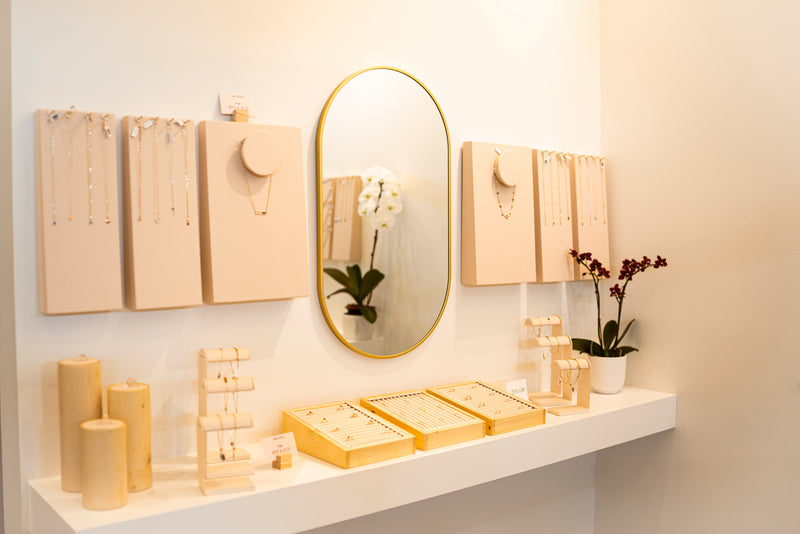
Come and see heart pendants side by side at Vanhess, 2929 Barnet Highway, Unit 2424, in Coquitlam Centre, or call +1 (604) 653-6449. Browse necklaces and pendants online, or the Olha New Collection for the Ruby Heart Necklace.
